


The comeback of nuclear energy: Rising as the new infrastructure of U.S. stocks in the wave of AI and manufacturing

Today, energy companies CEG and VST released their earnings, coinciding with unprecedented market attention on the energy sector, particularly nuclear power. Therefore, I decided to analyze the nuclear energy sector.
Nuclear energy, once considered an "old-era technology," is undergoing a complete reversal in the U.S. energy structure, re-emerging as a strategic cornerstone to support growth for decades to come.
This shift is driven by two structural forces:
The explosion in electricity consumption triggered by AI data centers
The reshaping of industrial energy structures driven by manufacturing reshoring
1. Dual Drivers: AI and Manufacturing Reshaping the Power Demand Curve
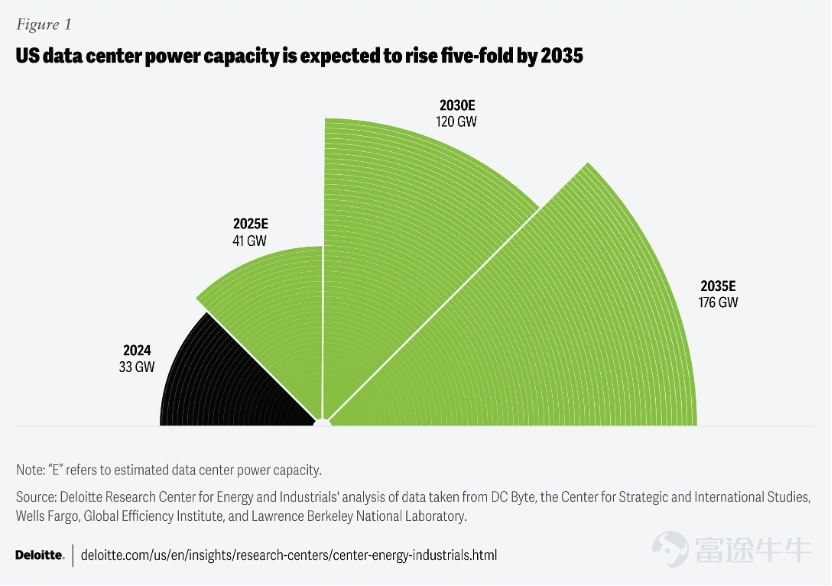
AI Data Centers: The New Black Hole of Electricity
With the rapid deployment of generative AI (e.g., ChatGPT, Claude, Sora), the U.S. is entering an unprecedented cycle of computing infrastructure expansion. Notably, AI models' power demand during the inference phase far exceeds that during training—each call to GPT-4 can consume 10 to 20 times more energy than a traditional search engine.
According to data from the International Energy Agency (IEA) and Bloomberg New Energy Finance (BNEF), by 2030, U.S. data centers will account for nearly half of the nation's electricity demand growth. AI-related computing alone could triple the share of data centers in total U.S. electricity consumption, reversing the trend of steady growth in power demand over the past decade.
Manufacturing Reshoring: The Rise of High-Density Energy Scenarios
Meanwhile, the U.S. government is systematically promoting manufacturing reshoring through policies like the CHIPS Act and the Inflation Reduction Act (IRA). Data shows that since 2021, annual growth in U.S. manufacturing fixed-asset investment has exceeded 8%, attracting companies like TSMC, Intel, and Samsung to build factories in the U.S. Recent tariffs have further incentivized reshoring, particularly in the semiconductor industry. As mentioned in this morning's recap, Apple has pledged to increase its U.S. investment to $100 billion.
2. The Optimal Solution: How Nuclear Power Meet the Core Demands of Future Energy Structures?
AI inference and training require continuous, stable power supply, as voltage fluctuations or outages can lead to model crashes or costly restarts. Manufacturing also demands stable power and reduced energy losses from long-distance transportation. Overall, this imposes two key requirements on energy:
24/7 uninterrupted power supply capability
High-density deployment near data centers
The Clean Energy Challenge
While solar and wind energy are widely promoted as zero-carbon solutions, they have inherent limitations:
· Intermittent generation, heavily influenced by weather and day-night cycles
· Require expensive, inefficient energy storage systems as backup
· Large land footprint, making deployment near cities or industrial parks difficult
These characteristics make them unsuitable for the "24/7 continuous power + high-density deployment" demands of AI and manufacturing.
Five Core Advantages of Nuclear Power
· High reliability: Nuclear plants have a capacity factor of 92.5%, far exceeding other energy types, making them the most reliable baseload power source.
· High energy density: Small amounts of nuclear fuel can provide massive amounts of electricity with minimal transportation and storage costs.
· Strong output capacity: A single reactor can stably output over 800 MW, meeting the needs of mega data centers or industrial parks.
· High land-use efficiency: Land required per unit of electricity is far lower than wind or solar, enabling intensive deployment.
· Flexible technology pathways: Small modular reactors (SMRs) are maturing rapidly, transforming nuclear power from "mega-projects" to "standardized products," improving scalability and capital efficiency.
With these advantages, nuclear power has become an indispensable solution for AI and manufacturing.
Tech Giants Betting Big: Energy Moves from Backstage to Center Stage
In the global expansion of AI infrastructure, energy is shifting from a "backstage support" to a "frontline strategic asset." Microsoft has signed a deal with fusion company Helion to build a commercial fusion reactor by 2028; Google, Amazon, and Meta are securing long-term power purchase agreements (PPAs) for carbon-free baseload power, including nuclear; OpenAI CEO Sam Altman's investment in Oklo is advancing reactor deployments for data centers.
To these giants, nuclear power is not optional—it is the foundational guarantee for the safe expansion of their AI ecosystems.
3. Future Potential: From Centralized Plants to Distributed Energy Cores
The true upside for the nuclear industry lies beyond meeting current power demands—it lies in its ability to integrate into more flexible, decentralized, and deeply decarbonized energy systems.
Scalability and Decentralization
SMRs and microreactors are designed for factory manufacturing, easy transport, and rapid incremental installation. This enables cost savings through mass production and allows projects to adapt to local demand, reducing investment risks. This modular, prefabricated, and rapidly deployable approach is shifting nuclear power from centralized mega-plants to a "distributed nuclear" model. This means nuclear can be deployed closer to demand centers (e.g., data centers, industrial parks, remote mining sites), reducing transmission losses and enabling tailored energy solutions, aligning with the trend toward distributed energy. This vastly expands nuclear's potential deployment scope.
Integration with Energy Storage
Nuclear plants can be paired with storage systems (e.g., pumped hydro, molten salt tanks) to store excess power for use when wind/solar supply is insufficient.
New Applications and Corporate Demand
Amazon is actively leveraging SMRs to achieve its net-zero carbon goals and has signed agreements to power its AWS data centers through innovative nuclear projects. This includes investments in X-energy's advanced reactor designs and collaborations with Dominion Energy to explore SMR projects. Nuclear's role in industrial heat and hydrogen production further expands its market.
Direct investments and SMR agreements by major corporations like Amazon signal that large enterprises are becoming direct drivers of nuclear deployment, potentially bypassing traditional utility models and accelerating adoption. This corporate demand for reliable, zero-carbon power could unlock vast private capital, speeding up the commercialization and financing of advanced nuclear technologies.
4. Conclusion: Nuclear Power Is Not a Story—It's the Return of Infrastructure
The narrative around nuclear power has shifted from "environmental alternative" to "the foundational infrastructure for computing and industrial resurgence." This reflects not just an evolution in energy forms but a strategic shift in U.S. industrial priorities.
We are at an inflection point in energy restructuring. Nuclear power is no longer a "distant future technology" but a real-world solution being embraced by tech giants, manufacturers, and capital markets.
Of course, investing in nuclear requires rationality: established operators like Constellation Energy (CEG) and Vistra CORP (VST) will steadily benefit from rising power demand, while startups like Oklo and NuScale represent longer-term, disruptive growth opportunities.
Tomorrow, I’ll analyze these key players based on the nuclear supply chain.
If you found this insightful, feel free to like and follow—thanks for your support!
The copyright of this article belongs to the original author/organization.
The views expressed herein are solely those of the author and do not reflect the stance of the platform. The content is intended for investment reference purposes only and shall not be considered as investment advice. Please contact us if you have any questions or suggestions regarding the content services provided by the platform.
