


 Posts
Posts Likes Received
The Roots and Foundations of a Bull Market

Investors in 科创 50ETF(588000) and Financial Technology ETF 华夏 (516100) sit at the main guest seat during a bull market, facing the red gate. The world is bustling for profit, and for many years, A-shares have naturally formed paths without words, with bodies lying by the roadside and beggars rampant. The long bear market of the past, like a beheaded queen, seemed endless; but good days seem to be coming.
I want to ask you, what is the foundation of the good days in a bull market? Our bull market has many names: reform bull, patriotic bull, non-kneeling bull, beautiful bull, parade bull, ETF bull, perhaps all have some truth, but I believe they are not the most important root of a long-term bull market; one of the most important roots is low interest rates or even zero negative interest rates; and "low interest rate bull" might be the name of the bull market.
Why does low interest rate foster a bull market?
Firstly, unlike many so-called "laws" in economics that are counterintuitive or illogical (which are mostly theoretical models or hypotheses with little practical significance), the logic behind the low interest rate bull is very logical:
1). The first and biggest logic is that the discount rate in valuation models decreases, leading to rising stock prices. All financial assets that generate cash flow in the future, such as bonds, stocks, and fixed deposits, are valued by discounting future free cash flow, where the discount rate = risk-free interest rate + risk premium; a decrease in interest rates will push up valuations.
However, different assets have vastly different sensitivities to interest rates (this "sensitivity to interest rates" is called duration in bonds). The duration thinking model can also be applied to all cash flow-generating assets. You can see that whether it's stocks or bonds, assets that receive 10,000 yuan after 10 years are likely to be more sensitive to interest rates than assets that receive 1,000 yuan after 1 year; and assets that receive 20,000 yuan after 20 years are even more sensitive, even if the 20,000 yuan may not be received in the end (you can get the expected value by multiplying the amount by the probability).
Empirical cases are also numerous and hard to count.
For example, the low interest rate bull in the US stock market, where companies like Tesla, whose majority of market value comes from imagined future businesses (robots, autonomous driving, going to Mars), soared. Stocks like Tesla and Palantir should be among the highest duration stocks (I traded interest rate cut expectations through these two stocks in practice); also, biotech companies are currently losing money, with future cash flows. Therefore, Tesla, Palantir, and the US biotech index have a high correlation with interest rates.
We are actually the same, some people don't understand why Cambrian is so crazy, Cambrian, 99% of its market value depends on business that is currently imagined but not yet formed, which is the highest duration stock asset; also why this wave of C asset bull market, Hong Kong stocks innovative drugs are the pioneers, 18A rose the fastest and most fiercely? — Firstly, innovative drug valuations are low, secondly, because innovative drugs have high duration.
High duration assets in the face of low interest rates are like old houses catching fire, like bachelors meeting Zhi Ling.
2) Of course, there are other explanations for low interest rates, such as lower funding costs, which are conducive to corporate financing and capital expansion, and corporate profit expectations may improve and increase. Additionally, abundant liquidity will improve market sentiment, bringing impulses, greed, jealousy, FOMO, etc. Loose monetary policy injects liquidity, supporting risk assets.
3) The third is easy to understand, even my grandmother can understand, which is the so-called asset substitution effect, where funds flow into the stock market, bond yields are low, savings interest rates are low, investors will seek higher-yielding assets, which is the origin of "deposit relocation bull". Opportunity costs are low, holding a pile of money without interest and depreciating, not going to the stock market would be heart-wrenching.
Stocks are good assets to resist inflation and make money grow.
In the long run, the negative correlation between interest rates and the stock market can be basically established. But note, this is a rule that is generally established in the long term but very uncertain in the short term, not a precise physical law like Einstein's theory of relativity.
For example, we can see if the experiences of various countries are universal, the US is the best example, after the 2008 financial crisis, the Federal Reserve's zero interest rate + quantitative easing (QE), the S&P 500 experienced a long bull market from 2009. In 2020, interest rate cuts + QE during the pandemic, US stocks quickly rebounded and hit new highs.
The long-term development chart of the US stock market, stretched to a century dimension, shows this negative correlation between interest rates and the stock market is quite clear.
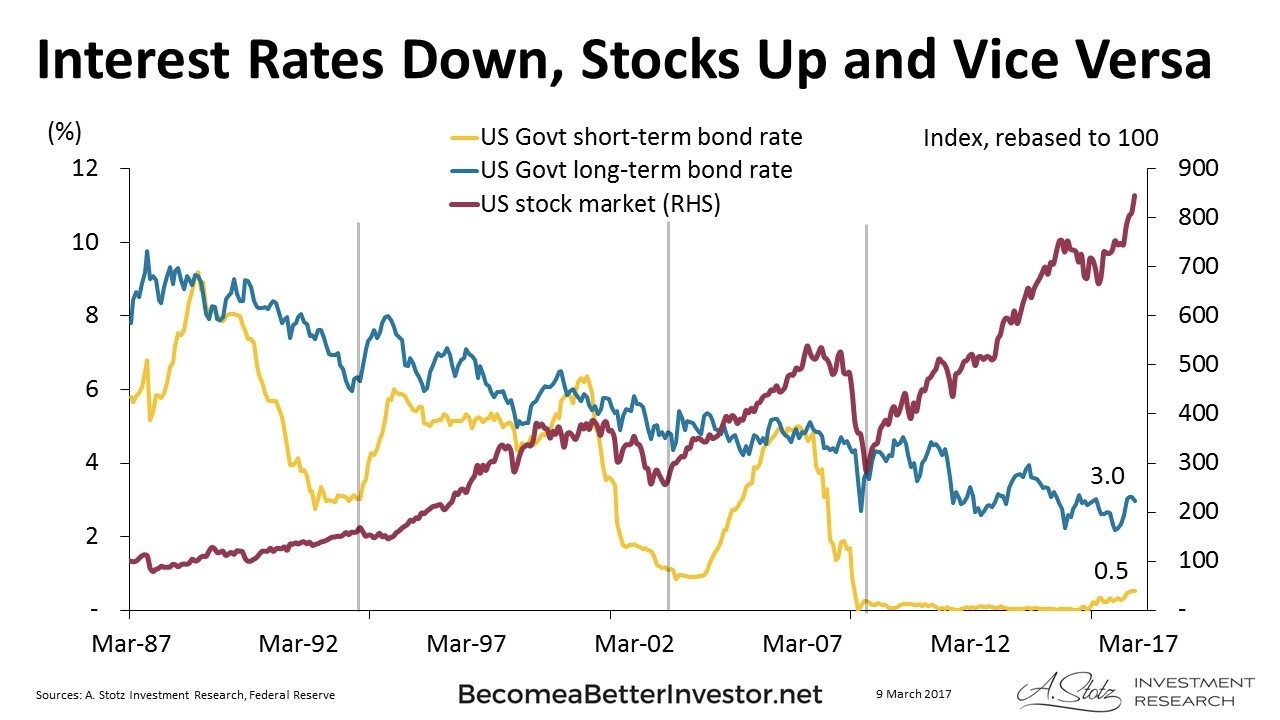
(Blue line interest rate level, red line stock market price)
Zoom in to a 30-year dimension, it's the same.
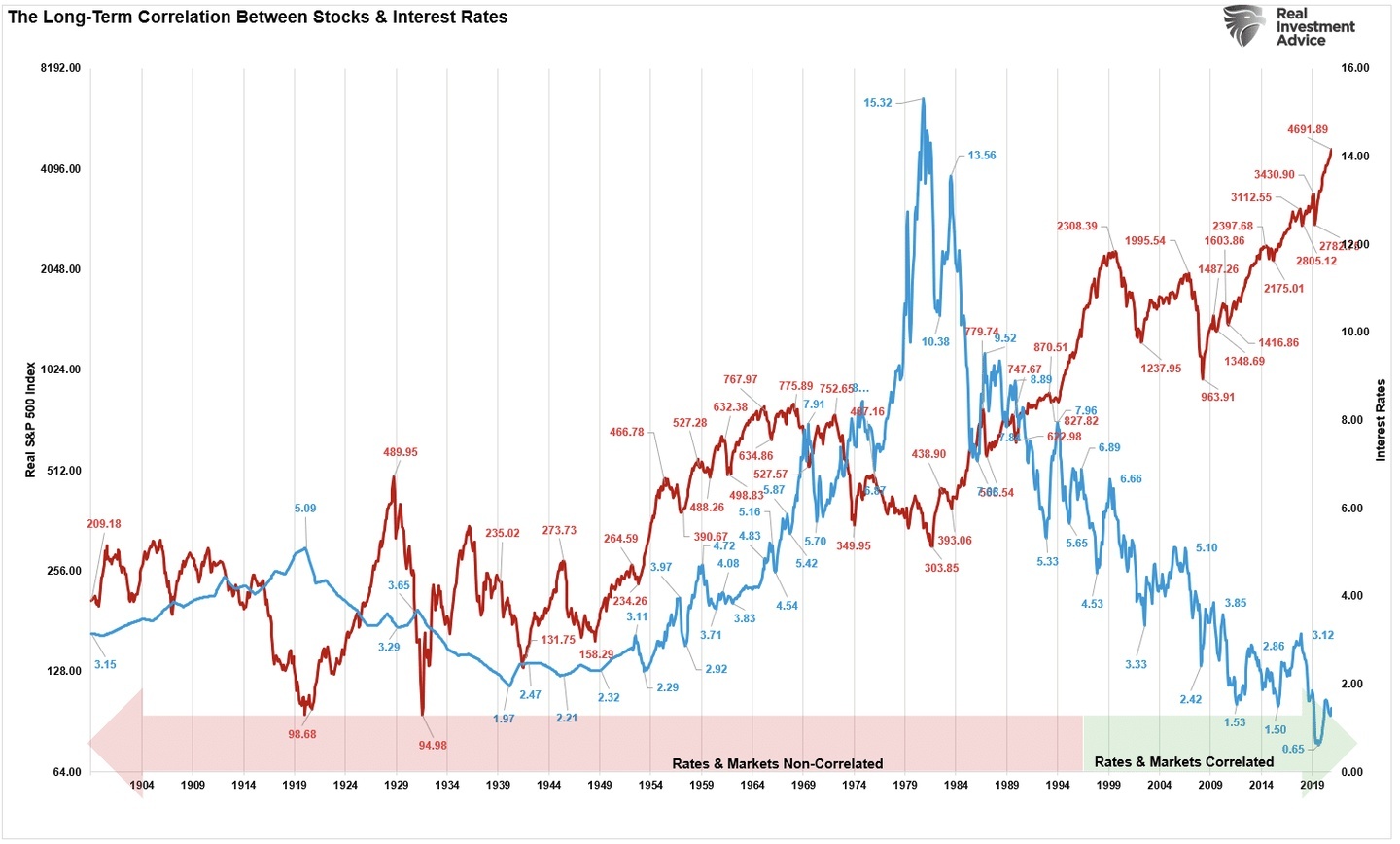
Additionally, actual interest rates and zero negative interest rate expectations are two different things, interest rates may be very low but stock prices may not rise for a long time until the market believes zero negative interest rates will exist for a long time, locking in low discount rates, and stock prices start to climb. I think this might be what happened in Japan and us. Domestic low interest rates have actually been quite long, why didn't stocks experience a big bull market in previous years? Because the market did not form a consensus on long-term low interest rates or even zero interest rates.
In other words, interest rate adjustments and stock prices are not like turning lights on and off with instantaneous causal relationships, stock prices may lead or delay significantly, even for a long time. It all depends on the marginal changes generated by market expectations absorbing information, and market expectations—known to all—are a mysterious thing.
Don't misunderstand, interest rates to the stock market are not like Newtonian mechanics or relativity such great truths or rules.
For example, Europe and Japan, long-term zero interest rates or negative interest rates, the stock market indeed eventually hit new highs, but Japan's new high came many years after the zero interest rate policy appeared (Japan started zero interest rate helicopter money around 2000). Under long-term easing, firstly, the company's fundamentals improved significantly; secondly, people found they couldn't keep buying Japanese bonds, which earned less than buying longer duration Japanese stocks, thus borrowing low-cost Japanese bonds to buy undervalued Japanese stocks, fostering a Japanese bull market.
And domestic monetary policy is relatively conservative, not as extremely loose as Europe, America, and Japan; but liquidity easing cycles (such as 2008, 2014, 2020) are indeed often accompanied by phased bull markets in stocks. In a short span of twenty years, one can roughly see a clue:
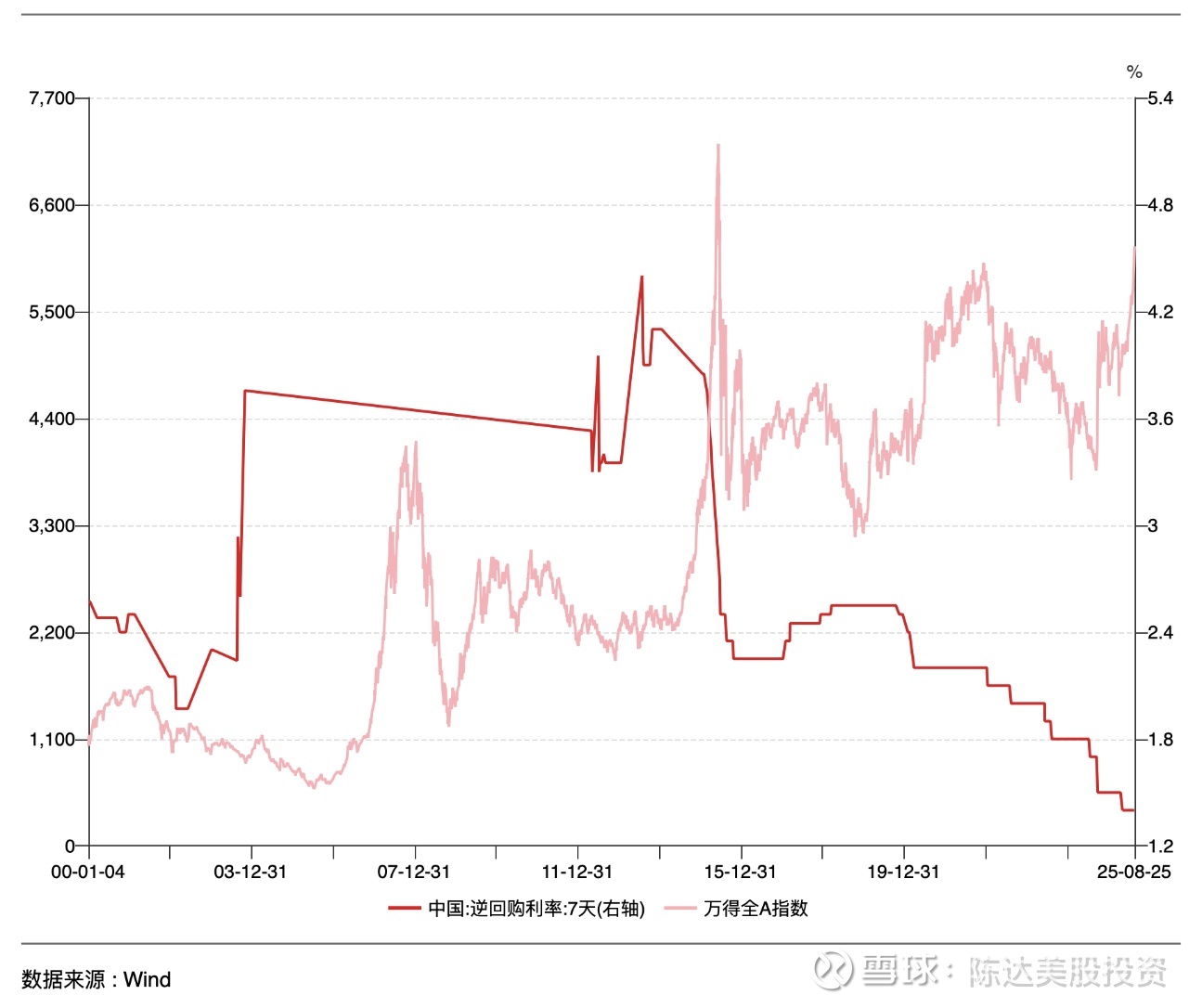
And our market's consensus on long-term low interest rates is like a large piece of concrete gradually drying, becoming harder and more solid. I believe this is the biggest foundation of this bull market, and also its biggest root for long-term development (add one of them, to be cautious).
In short, if inflation doesn't rise and low interest rates or even zero negative interest rates gradually become market consensus, then believing "the stock market is the barometer of the economy" is not as reliable as believing "the stock market is the barometer of interest rates", at least from historical evidence, it's much more reliable. Historically, the relationship between GDP growth and stock market fluctuations in various countries looks like a scatter plot made with a shotgun—seemingly unrelated.
Additionally, if we extreme the duration thinking, we can imagine things like artworks and Rolexes, which are assets that will only generate cash flow once in the future (when sold), actually have the highest duration. So guess why the global art market has been in a bull market for so many years since the 1980s.
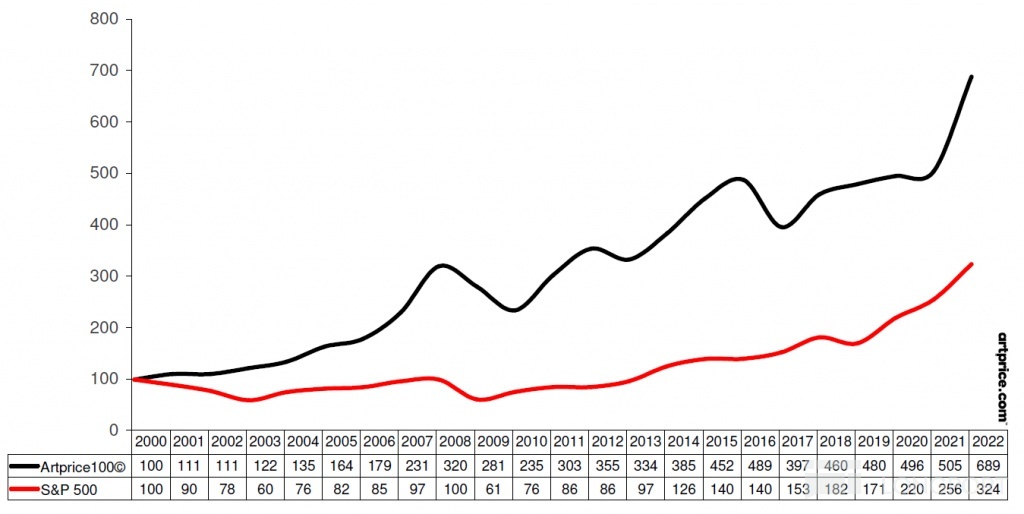
(Blue line Art 100 Index, red line S&P 500)
A point of view, not necessarily correct.
The copyright of this article belongs to the original author/organization.
The views expressed herein are solely those of the author and do not reflect the stance of the platform. The content is intended for investment reference purposes only and shall not be considered as investment advice. Please contact us if you have any questions or suggestions regarding the content services provided by the platform.
