


Financial stability, technology for good, industry benefiting the people: Three highlights of China State Construction International (03311.HK) 2025 interim results

In the first half of 2025, the global economy remained fraught with uncertainty, with geopolitical conflicts, volatile trade relations, and fluctuations in commodity prices continuing to impact economic development worldwide. Against this backdrop, China State Construction International Holdings Limited (03311.HK) $CHINA STATE CON(03311.HK) demonstrated strong resilience and strategic execution, achieving steady business growth and structural optimization.
According to its interim report, the company secured new contracts worth RMB 92.551 billion in the first half of the year, with revenue reaching RMB 56.643 billion, a year-on-year increase of 0.1%. Profit attributable to shareholders rose by 5.1% to RMB 5.259 billion, with basic earnings per share of RMB 1.01. The profit growth rate outpacing revenue growth typically indicates improved profitability. Additionally, the board announced an interim dividend of HKD 34 cents per share, with a payout ratio of approximately 31.1%.
Revenue from technology-driven businesses surged by 73.4% to RMB 20.54 billion, primarily due to increased market penetration of advanced construction technologies such as Modular Integrated Construction (MiC). In contrast, revenue from investment-driven businesses declined by 21.5% year-on-year to RMB 20.79 billion, reflecting the company's strategic focus on optimizing investment pace and selecting high-quality projects to enhance capital efficiency.
In the first half of the year, the company's profitability varied across regions. For instance, the gross margin in the mainland market was 22.8%, up 2.5 percentage points year-on-year, benefiting from the company's deep penetration into high-potential regions (such as the first implementation of the "order-repurchase" model in Dongguan and Jinan) and stringent cost control. In Hong Kong, the gross margin was 5.2%, down 1.9 percentage points year-on-year, mainly due to the sluggish local property market and developers slowing private project progress.
The company's net operating cash flow in the first half was RMB 123 million, an improvement of RMB 121 million year-on-year, marking the fourth consecutive year of positive cash flow. Notably, the cash collection ratio (cash flow to revenue) for mainland operations approached 100%, indicating excellent receivables management and efficient capital turnover.
As of June 30, 2025, the group's cash on hand reached RMB 33.197 billion, accounting for 12.0% of total assets. The net debt ratio fell to 65.2%, down 8.4 percentage points from the end of 2024, reflecting continued financial optimization. Unused bank credit lines totaled RMB 126.072 billion, providing ample funding for future expansion.
In March 2025, the company successfully introduced China Orient Asset Management as a strategic investor, securing nearly HKD 3 billion in funding. This not only optimized the capital structure (with the debt ratio expected to drop to 68.6%) but also opened avenues for future collaboration in areas such as distressed asset disposal and new infrastructure investment.
1 Technology for Good: MiC Technology Leads Construction Industry Transformation
In Hong Kong and Macau, China State Construction International, as one of the largest general contractors, consolidated its leading position in the first half of 2025. Revenue in Hong Kong surged by 39.6% to RMB 23.237 billion. In Macau, revenue fell by 61.8% due to a lack of large-scale projects, but the segment's profit decline was limited to 24.0%, demonstrating the resilience of its operational projects.
In the mainland, the company achieved continuous business optimization through improved management models and regional focus. Despite an 8.8% decline in revenue, segment performance grew by 4.3% to RMB 6.053 billion, reflecting improved project quality and profitability.
As the company's most significant technological innovation, the MiC model (Modular Integrated Construction) has been widely applied in urban renewal projects in key first- and second-tier cities, significantly improving the efficiency of traditionally time-consuming and costly renovation projects. For example, the Huapichang Hutong No. 8 dilapidated housing renovation project in Beijing's Second Ring Road area—one of the city's first "demolish-and-rebuild" pilot projects—serves as an excellent model for high-density urban renewal.
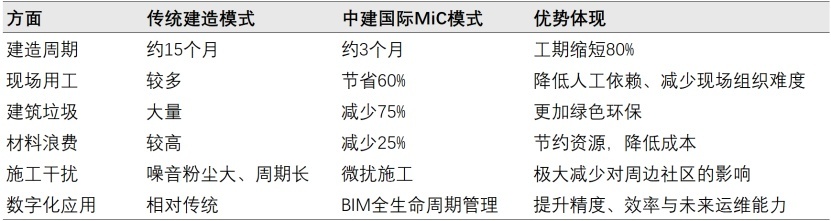
In this project, China State Construction International's subsidiary, China Construction HaiLong Technology, applied MiC technology, reducing construction time by 80%, labor by 60%, construction waste by 75%, and material waste by 25% compared to traditional renovation methods. Additionally, noise, dust, and environmental impact were minimized.
The table below summarizes the application and key outcomes of China State Construction International's MiC technology in this project:
Huapichang Hutong No. 8 is a five-story residential building constructed in the 1970s, classified as a Grade D dangerous structure. Located in Beijing's Second Ring Road core area, the project faced complex surroundings, limited space, high environmental requirements, and significant traditional construction disruptions.
The project team disassembled the building into 55 highly integrated concrete modular units. Over 90% of the work—including the main structure, insulation systems, pre-embedded pipelines, and interior finishing—was completed in an automated smart factory before transportation to the site. On-site work primarily involved lifting, assembling, and securely connecting these prefabricated modules. This parallel factory-and-site approach drastically shortened the construction cycle.
The project deeply integrated BIM (Building Information Modeling) technology and the Integrated Digital Delivery (IDD) concept. From design, production, and logistics to construction and operations, it achieved full lifecycle digital management, ensuring millimeter-level precision and efficient collaboration.
For structural safety, the project innovatively combined cast-in-place structures with modular wall membrane technology, employing reinforced shear wall systems and multi-level seismic designs. It also addressed aging-friendly needs by installing barrier-free elevators, safety handrails, and optimizing unit layouts to expand kitchen and bathroom spaces, while applying noise reduction and leak-proofing technologies to enhance living quality.
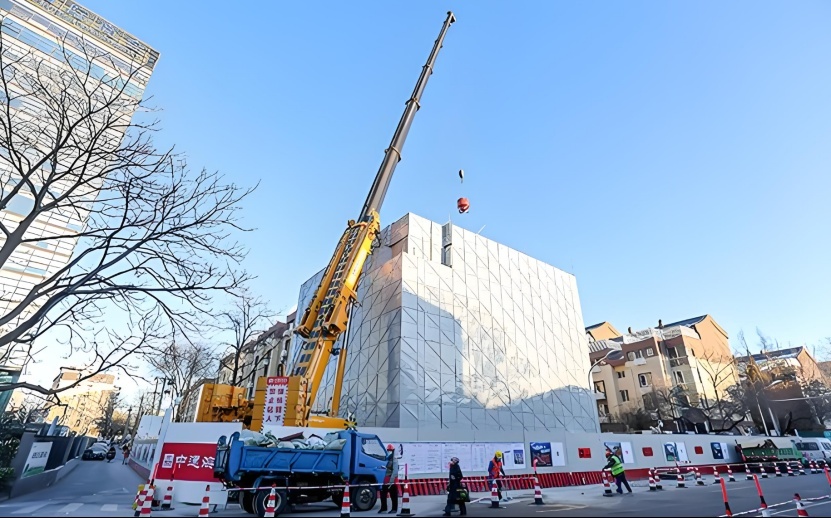
With the full application of the MiC model, the Huapichang Hutong No. 8 project not only showcased strong technological attributes but also maximized resident benefits, aligning commercial and social outcomes—embodying China State Construction International's "Technology for Good" philosophy.
The project took only about three months from demolition to resident relocation, compared to the typical 15 months or more for traditional methods. Rapid relocation significantly reduced residents' temporary housing costs and time, greatly enhancing satisfaction. The project was selected for the Ministry of Housing and Urban-Rural Development's first "Good Housing" best practices list. Upon relocation, residents received modern, high-quality homes with optimized layouts, complete amenities, and energy-efficient features.
The Huapichang project successfully validated the feasibility and superiority of MiC technology in renovating dilapidated buildings in high-density urban areas. It provides a "Beijing model" for similar urban renewal projects nationwide, exploring a win-win path for governments, tech firms, and residents.
2 Industry for the People: Advanced Technology and Model Innovation Deliver Social Benefits
China State Construction International has undertaken notable work in public welfare, particularly in affordable housing and urban renewal, achieving tangible results. Through innovative business models, advanced construction technologies, and corporate social responsibility, the company has driven these initiatives.
The table below summarizes the company's recent public welfare projects, their outcomes, and features:
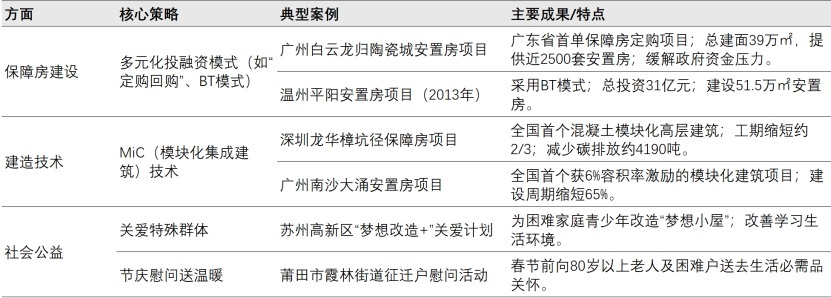
In advancing affordable housing, the company adopted multiple innovative financing and construction models to ease government funding pressures, accelerate projects, and ensure resident resettlement.
For example, the "order-repurchase" model was applied in Guangzhou's Baiyun Longgui Ceramic City resettlement housing project. The government released land via a "land price cap, repurchase price bid" method, with China State Construction International investing in construction before the government repurchased the completed units. This model reduced upfront government funding while locking in repurchase costs.
Earlier projects, such as the 2013 Wenzhou Pingyang resettlement housing, used the BT (Build-Transfer) model, where the company funded construction before government repurchase, similarly alleviating short-term local fiscal pressure.
MiC technology has also been widely applied in affordable housing, significantly improving speed and quality while being more environmentally friendly. For instance, the Shenzhen Longhua Zhangkengjing affordable housing project—China's first high-rise concrete modular building—was completed in just one year using MiC, two-thirds faster than traditional methods. It also cut carbon emissions by ~4,190 tons, reduced on-site labor by over 70%, and slashed construction waste by 75%.
The Guangzhou Nansha Dachong resettlement project, China's first modular building to receive a 6% floor-area ratio incentive, is expected to shorten the construction cycle by 65% using MiC. High-strength concrete and special techniques optimized indoor space without compromising structural safety.
Beyond its core business, the company has actively participated in social initiatives, such as Suzhou High-Tech Zone's "Dream Renovation+" program, where it built "dream rooms" for disadvantaged youth, and pre-holiday donations of essentials to elderly and needy families in Putian.
These efforts underscore China State Construction International's commitment as a state-owned listed company.
4 Conclusion
In the first half of 2025, China State Construction International delivered strong results amid economic challenges. With robust finances, ample cash flow, and leading traditional construction operations, the company continues to optimize its structure while breakthroughs in curtain wall internationalization form new growth drivers. These factors lay a solid foundation for high-quality development.
Guided by "prudence, diligence, and excellence," the company seeks opportunities in transformation and advances steadily through challenges. Moving forward, it will uphold its "technology-led, green development" strategy, deepen its presence in Hong Kong and Macau, expand premium mainland projects, and promote green technologies like BIPV and MiC to enhance ESG performance and market recognition.
The copyright of this article belongs to the original author/organization.
The views expressed herein are solely those of the author and do not reflect the stance of the platform. The content is intended for investment reference purposes only and shall not be considered as investment advice. Please contact us if you have any questions or suggestions regarding the content services provided by the platform.
