


The richest man's net worth is 530 billion yuan, but his "vaccine money printer" is slowing down, Wantai Biotech struggles to be a "disruptor"

A few days ago, the 2025 Hurun China Rich List was released, with Zhong Shanshan, the controlling shareholder of Nongfu Spring and Wantai Biotech, becoming China's richest person for the fourth time, with a net worth of 530 billion yuan. Such massive wealth accumulation undoubtedly benefits from the dual-drive model of "water + vaccines."
However, upon closer inspection, there are still a significant difference in the development of the two major segments: compared to "selling water," the vaccine business seems harder to operate, and its stability still has much room for improvement.
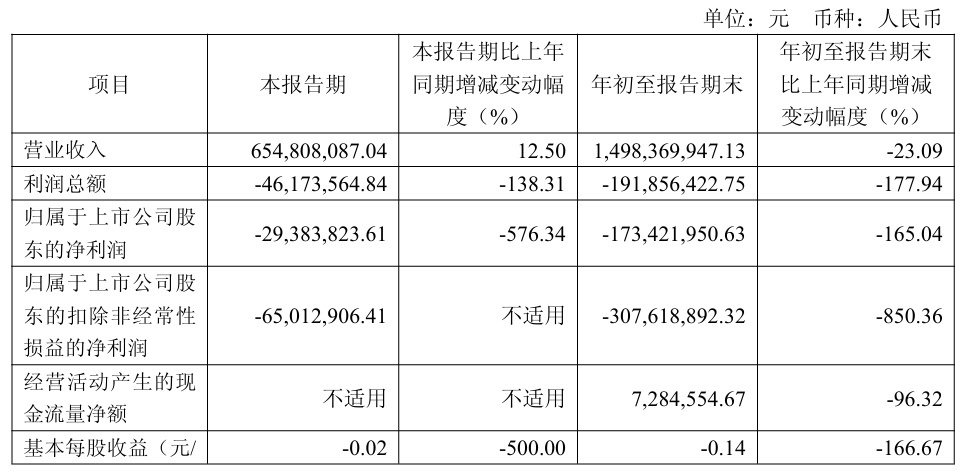
According to Wantai Biotech's latest Q3 report, the company's revenue for the first three quarters of this year reached 1.498 billion yuan, a year-on-year decrease of 23.09%; net profit attributable to the parent company was a loss of 173 million yuan, down 165.04% year-on-year; and adjusted net profit attributable to the parent company was a loss of 308 million yuan, down 850.36% year-on-year.
In the third quarter alone, the company's revenue was 655 million yuan, up 12.5% year-on-year; net profit attributable to the parent company was a loss of 29.3838 million yuan, down 576.34% year-on-year; and adjusted net profit attributable to the parent company was a loss of 65.0129 million yuan, with the loss further expanding.
Despite having leading vaccine products and the support of in vitro diagnostic services, why is Wantai Biotech's "money-printing machine" struggling to gain traction?
Domestically Developed 9-Valent HPV Vaccine Takes the Lead, But Can It Disrupt the Market?
In June this year, the most notable event for Wantai Biotech was the official approval of its self-developed Cecolin®9 by the National Medical Products Administration, making it China's first and the world's second approved 9-valent HPV vaccine.
In terms of pricing, Wantai Biotech has also shown strong determination for domestic substitution. It is reported that Cecolin®9 is priced at 499 yuan per dose, only about 40% of the market price of imported 9-valent HPV vaccines.
Additionally, the market expansion of this product has accelerated. The financial report mentioned that on September 9, 2025, the global first-dose ceremony for Cecolin®9 was successfully held in Xiamen, Fujian. During the reporting period, the company completed batch releases for 9 batches of the 9-valent HPV vaccine, gained access in 16 provinces, and administered the first doses in 7 provinces/autonomous regions/municipalities.
However, based on current performance, the disruptive impact of this breakthrough product on the market has yet to materialize or remains limited. The short commercialization period is one factor, but more importantly, the product's application prospects may not be as broad as imagined.
In fact, as Wantai Biotech seeks to break through with its pricing advantage, established players in the 9-valent HPV vaccine market have already devised countermeasures. It is reported that since May this year, with promotional activities such as "buy one, get one free" (for females aged 9-14) and "buy two, get one free" (for females aged 35-45), news has emerged from multiple cities in China about significant price drops for Merck's 9-valent HPV vaccine, originally priced at 1,320 yuan per dose. The price competitiveness of imported 9-valent HPV vaccines has already strengthened.
Behind this, the market environment has undergone significant changes.
On the demand side, although the overall HPV vaccination rate in China is not high, most willing and able individuals have already been vaccinated, while the unvaccinated group is constrained by economic conditions and other factors. The era of "hard-to-get doses and scalpers snatching appointments" for 9-valent HPV vaccines is long gone.
On the supply side, many manufacturers are still ramping up R&D. Currently, the 9-valent HPV vaccines from several domestic pharmaceutical companies, such as CanSino Biologics, Walvax Biotechnology, and Recbio, have entered late-stage clinical trials. It is expected that the "more monks, less gruel" scenario in the 9-valent HPV vaccine market will become more pronounced.
Therefore, the investment market remains concerned about the prospects of Wantai Biotech's new product. But at present, the company indeed has few strong growth engines to rely on.
Core Business Under Shadow: Where Are Wantai Biotech's Growth Opportunities?
In the vaccine sector, Wantai Biotech has always had a clear first-mover advantage in technology.
The financial report mentioned that the company possesses a proprietary E. coli prokaryotic expression virus-like particle vaccine technology platform. Based on this, it has commercialized three technologically leading vaccine products: the world's first hepatitis E vaccine Hecolin®, China's first bivalent cervical cancer vaccine Cecolin®, and China's first 9-valent cervical cancer vaccine Cecolin®9.
Among them, the bivalent HPV vaccine Cecolin® was officially launched in mainland China (excluding Hong Kong, Macau, and Taiwan) in May 2020 and once disrupted the market with its label as "China's first and the world's fourth approved cervical cancer vaccine" and its pricing advantage.
According to public information, Cecolin® was initially priced at 329 yuan per dose, with females aged 9-14 receiving two doses for 658 yuan and those aged 15-45 receiving three doses for 987 yuan, while the price of GlaxoSmithKline's imported bivalent HPV vaccine was twice as high. With such a lead, Wantai Biotech once enjoyed significant market dividends.
However, with the approval of Walvax Biotechnology's bivalent HPV vaccine Wozhihui® and the expansion of Merck's 9-valent HPV vaccine's target population, Cecolin® has gradually lost its foothold, and the company's performance has begun to cool.
The financial report shows that in 2022, Wantai Biotech's revenue reached 11.185 billion yuan, a year-on-year increase of 94.51%, and net profit reached 4.736 billion yuan, up 134.28% year-on-year. By 2023, the company's revenue was 5.511 billion yuan, down 50.73% year-on-year, and net profit was 1.248 billion yuan, down 73.65% year-on-year. This downward trend continues to this day.
It is worth noting that Wantai Biotech has also been deeply involved in the in vitro diagnostics field for many years, developing numerous diagnostic reagents and instruments, but the challenges in this market are equally significant.
Wantai Biotech's interim report stated: "During the reporting period, the domestic in vitro diagnostics industry was significantly impacted by centralized procurement price cuts, DRG (Diagnosis-Related Groups)/DIP (Diagnosis-Intervention Packet) payment reforms, and ongoing anti-corruption efforts in healthcare. The competitive landscape is gradually evolving toward deeper integration. Although the industry boasts a market size in the hundreds of billions and maintains relatively high growth rates, and domestic brands continue to gain market share, the concentration of many companies in mainstream segments has led to bottlenecks such as converging technology paths and insufficient product innovation capabilities. Establishing differentiated competitive advantages has become key to breaking through homogeneous competition."
Under multiple pressures, Cecolin®9 has become the much-anticipated product. However, as mentioned earlier, with rapidly changing market demands and intensifying competition, how can Wantai Biotech unlock growth opportunities?
Currently, Wantai Biotech's answer is to expand overseas and ramp up R&D. According to the financial report, Cecolin® has now gained market access in 23 overseas countries and been included in immunization programs in 8 countries. To prepare for the overseas expansion and market access of Cecolin®9, Wantai Biotech has initiated market research and access evaluations in multiple regions in the first half of the year, aiming to enter more middle- and high-income core markets.
At the same time, the company has multiple products in the pipeline, including a recombinant herpes zoster virus vaccine, a recombinant trivalent rotavirus subunit vaccine, a recombinant respiratory syncytial virus vaccine, a third-generation HPV vaccine, a freeze-dried varicella attenuated live vaccine, a freeze-dried varicella attenuated live vaccine (VZV-7D), a nasal spray trivalent influenza attenuated live vaccine, and a universal influenza vaccine.
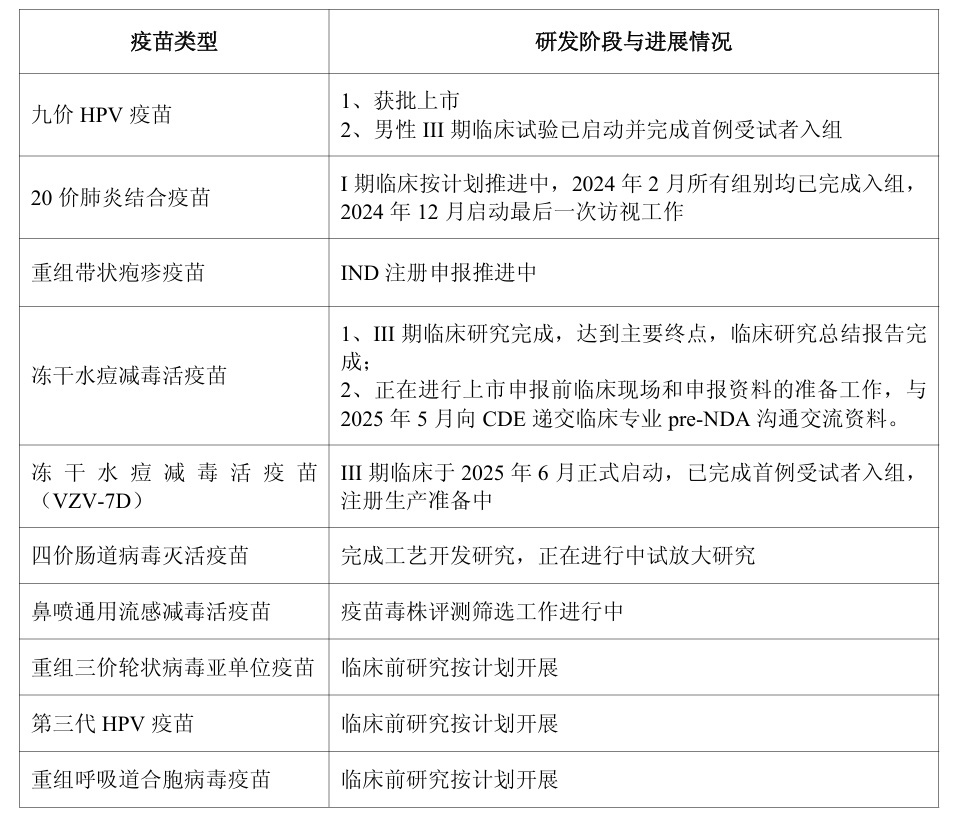
These may all be essential building blocks for future growth.
Source: Pharmaceutical Research Society
The copyright of this article belongs to the original author/organization.
The views expressed herein are solely those of the author and do not reflect the stance of the platform. The content is intended for investment reference purposes only and shall not be considered as investment advice. Please contact us if you have any questions or suggestions regarding the content services provided by the platform.
