Counterpoint:2025 年上半年全球高端智能手机销量同比增长 8%

According to a report by Counterpoint Research, global high-end smartphone sales are expected to grow by 8% year-on-year in the first half of 2025, reaching a record high, with a growth rate higher than the overall global smartphone market's 4%. The high-end market contributed over 60% of global smartphone revenue, with Apple remaining the largest brand, although its market share has declined. Huawei and Xiaomi performed strongly in the Chinese market. Google has returned to the top five high-end smartphone brands, with sales doubling
According to a report released by Counterpoint Research, global high-end smartphone sales are expected to grow by 8% year-on-year in the first half of 2025, reaching a historical high for the first half of the year; this growth rate exceeds the overall global smartphone market, which only grew by 4% during the same period. As consumers continue to deepen their usage and stickiness with smartphones, and upgrade to high-end devices against a backdrop of improved affordability, the trend of "premiumization" is becoming increasingly evident across regions. Most brands and regions benefit from this trend. Overall, the high-end market contributes over 60% of global smartphone revenue, highlighting its strategic importance.
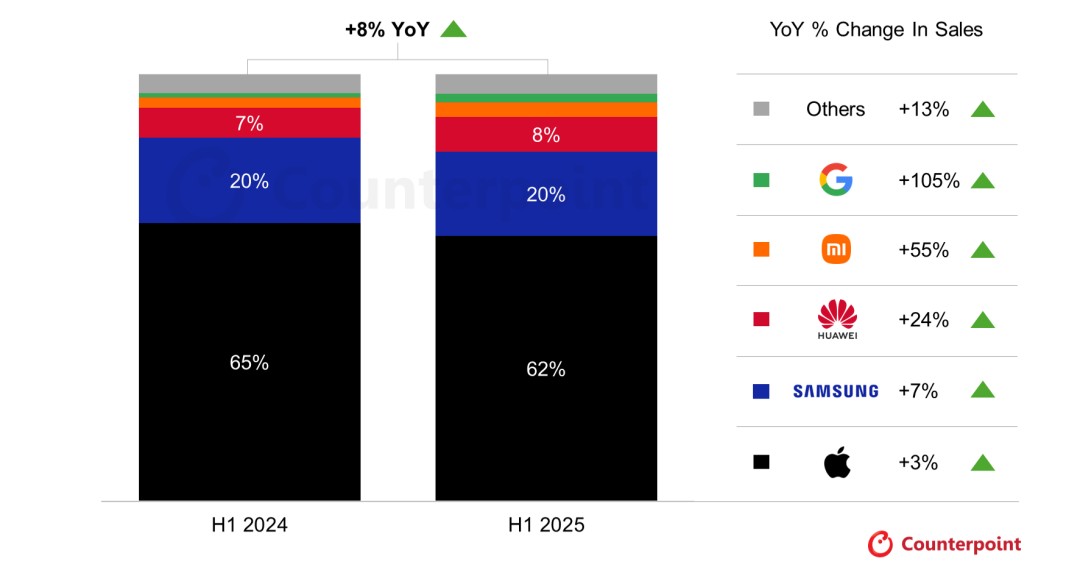
Apple remains the largest brand in the first half of the year, with a year-on-year growth of 3%, capturing a 62% share of the high-end market. However, due to faster growth from other OEMs, Apple's share has declined: while its performance in emerging markets has improved, it is being encroached upon by Huawei and Xiaomi in China. With a loyal user base and strong offline coverage, Huawei remains highly attractive in China, continuously regaining market share and winning consumer favor through unique designs such as the tri-fold Mate XT.
Global high-end (> $600) smartphone market unit sales share (by OEM)
H1 2025 vs H1 2024

Source: Counterpoint Research smartphone model sales tracking, Q2 2025
Xiaomi has also shown significant improvement in the high-end segment in China. It is not only advancing the premiumization of its smartphone business but also making strides in electric vehicles (EV) and the Internet of Things (IoT); the halo effect of high-end EVs is feeding back into the smartphone business, while smartphones are deeply integrated with EVs and IoT.
Google has returned to the top five high-end smartphone brands after five years. Its sales have doubled year-on-year, driven by strong performance of the Pixel 9 series, expansion into new markets, and more aggressive marketing. Google is positioning the Pixel series as AI-first devices with a pure software experience, rather than just emphasizing hardware specifications, and consumer confidence in Pixel is steadily increasing.
Samsung has achieved growth through the S25 series, which has outperformed the S24. Looking ahead, benefiting from significant hardware upgrades, the Z Fold7 is also expected to outperform its predecessor.
From a country/region perspective, the top ten high-end markets account for nearly 80% of sales in this segment, with India being the fastest-growing market, achieving a synchronous growth of 37%, primarily driven by Apple's strong performance and convenient financing, significantly expanding the accessibility of high-end devices. In absolute terms, China, as the world's largest high-end market, remains the biggest contributor to growth Foldable screens remain a niche but growing category—both a key lever for brand differentiation and a strategic step to expand high-end/luxury product lines. For consumers, foldable screens bring a refreshing experience in form. Apple is expected to enter the market in 2026, which may further drive growth in this segment.
In terms of AI, devices with generative AI (GenAI) capabilities are expected to account for over 80% of high-end smartphone sales in the first half of 2025. High-end consumers continue to favor cutting-edge innovations, and brands are positioning GenAI as the next key differentiator in this segment. As hardware gaps narrow, consumer choices will increasingly depend on the AI ecosystem